Showing posts with label ulster scots. Show all posts

Wednesday, 14 May 2014

Great Service from the Customar Service

From the collection "Intimacy Under the Wires" by Sivan Askayo, taken from Ignant.de

I have compared the first page of the translation to Ulster Scots of the "Customer Service Standards2007-2008" of the Department for Employment and Learning (DEL) to the original (English) version. From my analysis it is clear that this translation does not follow the "strategy for Ullans" which Kirk has recorded after reading the DARD “Hannlin Rede 2010-2011”. This strategy consists of the following steps:

·     Avoid French- or Latin-derived vocabulary
·     Avoid abstractions lexically and at every other level
·     Avoid mass nouns
·     Maximise dynamic actions or activities
·     Use lexical obsolence
·     Use dialectisms, including any Ulsterisms
·     Maximise synonyms or alternatives
·     Maximise use of alternative syntax
·     Maximise respellings (use eye dialect)
(Kirk 2013: 295)

In the DEL “Customar Service Staunarts” French- and Latin-derived vocabulary is not avoided, as the title already shows. Within the excerpt we find among others: depairtment, qualitie, pairticular, access and formats.

The “Hannlin Rede” explicitly sets out the vision (spaesicht) of the DARD, while the “Customar Service Staunarts” talk about specific rules and measures for the treatment of DEL customers. The “Hannlin Rede” is therefore on the whole a level of abstraction higher than the “Staunarts”, which is reflected in the language use by fewer abstract references or mass nouns. This makes it a bit hard to compare, but overall it seems like abstraction is not avoided in the DEL translation. The abstraction employment is translated to employ. Employ is only listed as a verb ("to make use of") in the Dictionary of the Scots Language (DSL), indicating it may be a recent coinage, possibly modeled on the French emploi. It bears the same degree of abstraction as employment. The abstract terms service and commitment  have been left untranslated.

The translation cannot be said to maximise dynamic actions or activities. Some changes are more and others less dynamic. Expect ("the standards of service that you can expect from us") has been replaced with leukan tae get. Expect in this sentence implies "regard as likely to happen", which is a passive thing to do. Leukan tae get implies much more activity and it is also a change of tone towards the more colloquial. At the other hand tells you about has been replaced with gies you wittins anent, which is more formal and more abstract. Because "giving information" is more abstract than "telling about" it is also less dynamic.

Alternative words and synonyms have not been maximised in this excerpt; such words as business, programs and customar could have been replaced, but have not. One could even ask if it is always justified to leave the original word; for instance for customar the only result in the DSL is "An official having charge of the customs; a customs officer." However if a word with the meaning of the English customer did not yet exist in Ulster-Scots, it seems fair enough to borrow that meaning into the language as it is less obfuscatory than the periphrasis tha yins we'r fennin/dalin wi (DARD 2010: 1).

There are some notable syntax changes. In two instances superlatives are created through adding -maist as a suffix. This is not mentioned in Robinson's grammar guide (1997), however it is mentioned in an online Scots language course: "In words of two or more syllables the comparative is formed by prefixing mair, and the superlative is formed by suffixing maist." (Eagle 2001: Adjectives). 

In some subordinate clauses the finite verb is left out: An us no aible for tae dae it, we will gie an expoun. Verbless subordinate clauses are indeed a common feature of Scots, although  Robinson (1997: 111) suggests they are normally used to express surprise or indignation, which is not the case here.

There is one instance of a verbal concord in the excerpt: Some airts o our business haes customers staunarts relate to aefauld programs. There is also one instance of the form bes of the verb 'to be': We will mak sicar our facilities bes redd up, bien an open. Robinson (1997: 149) indicates that the verb form bes can be used to indicate a "'habitual' or ongoing condition". This means that its use here is appropriate.

Alternative spellings are used, but not maximised; a lot of words are left the same as in the English version. Where respellings are used they are consistent and usually they have precedents in Scots or Ulster Scots literature. Examples are prent/prentit, appyntment (precedent: appeynt, DSL), Inglis. Depairtment is cited in the DSL with several precedents starting in 1985, suggesting that it is an innovation from the current wave of language revival. Caars is a logical, if slightly confusing, adaption of caa which is a precedented way of spelling the cognate of "call" in Ulster Scots, seen for instance in Philip Robinson's poetry. The spelling -fu for the suffix as in helpfu is widely used in Ulster Scots, respelled to reflect distinct pronunciation (See for instance "mournful" in Fenton 2006: 250). Some alternative spellings that have been used in other Ulster Scots texts have note; for instance for is used here, whereas the Hannlin Rede uses fur and service is used whereas the Euraip Chairtèr fur Kintra-pairt ur Unnèr-Docht Leids uses sarvice (DFP 2005: 16).

So, what strategy does the DEL document use? The text can be seen in the context of Jean Ure's explanation of how new registers are developed (see chapter 2). As said, to develop new registers either contemporary registers may be drawn upon and extended; where forms from an earlier period are preserved these provide patterns that may be activated to suit new needs; and other languages may provide models on which new registers can be based. The DEL text employs a mix of these to create a new register in Ulster Scots. Colloquial Ulster Scots (caars, meenit, leukan tae get, helpfu) is mixed with medieval Scots conventions (qualitie, prent/prentit, Inglis, verbal concord), thus extending contemporary Ulster Scots registers and reactivating forms from an earlier period. The English-language original text is translated word for word and phrase for phrase into Ulster Scots, meaning that the conventions of the model register are maintained in the new register in Ulster Scots. The result is clearly Ulster Scots, yet it does not come off as de-intellectualised but rather as suitably formal for the text's purpose. Within the confines of the genre – Civil Service Ulster Scots – this is the best kind of translation one could have hoped for.

The Language Revival Efforts of the Department of Agriculture and Rural Development

 The Department's promotional image on their Rural Development page.

Now that we have a solid impression of Ulster-Scots poetry, it is time to move on to an analysis of a wholly different genre that has popped up in the last few decades: Civil Service Scots, or official translations from English-language government documents to Ulster-Scots.

1(a) Why was this text created?

The question of why official documents are translated into Ulster-Scots is an interesting one. Especially if the translations contain unprecendented spelling and neologisms that may make the text quite hard to understand to actual Ulster-Scots speakers, the translations appear as unnecessary money waste at best and actually harmful to the development of the language at worst. Gavin Falconer (2004: 68-70) argues that the "minor revolution in official translation" that is underway in Northern Ireland is a result of parity of esteem and human rights discourse gone wrong. He writes:
 "Some of the commissions received by us have been instigated by a single individual's decision to make an issue out of the fact that a document has been translated into one language without any equivalent translation into the other - a precarious basis both for a business and for language revival. Some of our lengthiest translations have been commissioned on the off-chance of such a complaint arising without any intention of publication."
It is not clear that this is the common treatment of translations of all government departments. The DARD states in their 2011 document Language Policy for Irish and Ulster Scots that translations will routinely and pro-actively be done of material if it is intended for wide usage; if it is of particular relevance to Irish and Ulster-Scots speakers, or if it will contribute to safeguarding and promoting the language. Information leaflets do not necessarily need to be printed in all languages, but should be made readily available digitally "when required". Furthermore "when requested", translations of other documents will be considered, "subject to cost and value for money considerations".

Rural cottage in Co. Tyrone, on filmlocations.co.uk

In a later article Falconer (2005: 57) suggests six criteria for what makes a good translation into Ulster Scots:
  • Will readers be able to access the information in the text by drawing on a familiarity with traditional Ulster-Scots literature? 
  • Since so many users, even of full Ulster Scots, are literate only in English, will readers be able to access the information in the text drawing on a familiarity with the ortographic practices of that language? 
  • Is the spelling of the text logical and consistent?
  • Is all the information in the English text given in the Scots translation?
  • Are the translations used for individual terms consistent, including across different translations, or are they being coined on an ad hoc basis?
  • Would a back translation into English produce something close to the original, in a comparable register and without excessive paraphrase?

Thursday, 8 May 2014

Is Ulster Scots a dying language?

Nursery rhyme art project by children from the Mall-ard's Kindergarten

Ulster Scots is in intensive contact with English and, to a lesser extent, Irish. Most Ulster Scots speakers are fluent in English and use it frequently both actively (e.g. in school, making it their language of literacy) and passively (e.g. on TV and in newspapers.) English is the more sizable, more dominant and overall more prestigious language. Based on these facts the situation of Ulster Scots makes it very likely that the language is degenerating rapidly, and makes gradual language death a very plausible outcome. We can therefore expect to find loss of registers and associated language forms; loss of lexicon, phonology, morphology and syntactic patterns, and replacement of lost aspects with English equivalents.
It is quite difficult to investigate exactly how and when the language contact with English has influenced the lexicon and structure of Ulster Scots, because few documents survive that were written in Scots in Ulster. This is because English was in the process of becoming the language of literacy already by the time the plantation began.

As shown by Montgomery and Gregg (1997: 584-8), Scots writing conventions gave way to English conventions in Ulster, as they did in Scotland, in the second half of the 16th century and the first half of the 17th. At the end of this period distinctive Scots writing conventions such as quhilk or thir and grammatical features such as the indefinite article ane and the northern verbal concord had all but disappeared.That they had disappeared from writing does not necessarily mean that they had disappeared from speech as well; for instance, the geographical distribution of Scottish settlements during the Ulster plantation is almost exactly the same as the boundaries of Ulster Scots speaking areas found by Robert Gregg in the 1970s and 1980s (Montgomery and Gregg 1997: 578), indicating that the language in fact continued to be spoken by much of the population.

The way that speech has changed is even harder to establish for the plantation period, if not impossible, because there are no spoken records available and we do not know whether surviving texts are a good representation of pronunciation. About speech change in modern Scots we know more. Caroline Macafee (2003: 55) has interviewed urban Glaswegian Scots speakers, which, although not directly relevant to the situation in Ulster, has resulted in a useful overview of the processes of speech change. She focuses on lexicon and finds that indeed, distinctive lexicon is disappearing. While older generations do still have passive knowledge of distinctively Scots words, they do not use them themselves but instead opt for English counterparts and English cognate forms, meaning their children no longer have even passive knowledge of the Scots terms. Scots words lose their full range of meaning, instead becoming specialised to particular senses; some of them are preserved only in compound forms or nursery rhymes.

Tuesday, 29 April 2014

Thocht-Polis, by Philip Robinson

  
Funny cow number 22, from FunnyPica.com

Full text of the poem: Thocht-Polis, by Philip Robinson.

1(a) Why was this text created?
  (b) What motivations does the author have for his style choices? (Extent of distinctive Scots vocabulary and grammatical aspects; neologisms and other innovative language use; spelling; distinctive form; imagery.)

Philip Robinson is well-known among modern-day Ulster-Scots enthousiasts, for his novels and poetry in the language and his position on various boards, societies and councils for Ulster-Scots (read more here), and importantly for the extensive Ulster-Scots grammar guide of his hand. As well as two published volumes of poetry he has three poetry weblogs, one for contemporary free-verse, one for humorous poems and one for poetry in traditional stanzas. The wide range of genres and styles suggests Robinson is consciously trying to expand the literary "reach" of the Ulster-Scots language.

He grew up in Boneybefore, which is not far from James Orr's native Ballycarry. His language use is similar to that of Orr, but with considerable differences in spelling and noticeable neologisms here and there. His own spelling is not consistent across or even within the poems.

"Thocht-Polis" is one of the poems in Alang tha Shore (published 2005), and it is also featured on his blog Mair rhymin Ulster-Scotch crack, the one with humourous poems, or as Robinson puts it "writ fur a bit o a lach". It brings opponents of the Ulster-Scots language on stage as "tha Flet-Earth Societie". To them everything is black or white, and hence they cannot understand the Ulster Scots, who fall between two traditions; they are "black and white" at the same time just like the Frisian cows.

Differences in spelling between Orr and Robinson's poems include such common words as the, I and they, spelled in that way by Orr. Robinson spells the article tha, the first person pronoun A and for they he variously uses the' (in "Whit ir the' at?" and "The' lach and rage"), they (in "Whuniver they thegither play", "They cannae thole" and "To bigger beece they turn't"). It isn't entirely clear what the distinction depends on, though most likely the' is the unemphasised version. The verse is written in iambic tetrameter, but the they spelling is variously used in the emphasised and unemphasised positions. The' however is only found in unemphasised positions. The spelling of the word what is not consistent either; in the online version of the poem it is spelt whit thrice and once whut. The version that was reprinted in Frank Ferguson's anthology of Ulster-Scots writing uses whit once, whut twice and once what. In other poems he uses quhit as a spelling too, e.g. in The Gaelic Archipelago.

Where Burns and Orr both use ca'  (for call) and a' (for all), Robinson uses caa and aa. He uses thocht while Orr spells this word thocht and roon where Orr uses roun'. Altogether Robinson uses a lot more spellings that mark the words as distinct from standard English. As said the discussed poems by Burns and Orr were both in relatively "thin" Scots. Yet the poem "Donegore Hill" by Orr which was in thicker Scots still contains the same spellings as "Death and Burial" does, it just contains more Scots words than the latter.

Why might Robinson be using more distinctive spelling? It may be just be an idiosyncratic thing; in an unstandardised language much is allowed. But the distinctiveness of his spelling choices seems to be in line with the general rule that the more suppressed a language group feels about their language use, the more they will try to emphasise the distinctiveness of their language. James Orr was writing before the education laws of the 1830s, with a nationalised corpus which enforced use of standard English in the classroom. These laws contributed a lot to the stigma against the Ulster-Scots language, as children were told from early on that their way of talking was wrong. Indeed Thocht-Polis is railing against the stigma on the language. In Tha Gaelic Archipelago, too, Robinson hints at the stigma in the lines "Ay. / Sorry - Yes. / We'r learnt we maun aye say YES."

The extent of distinctively Scots words in Thocht-Polis, as in ones that do not have a cognate word in English, is actually not that big. Gin is used, ocht, thole and blethers and the expression deil a haet. This is still more sistinctive language than used by other contemporary Ulster Scots poets. Charlie Reynolds in his poem Mae Mither's Tunge uses almost exclusively what John Kirk (2013: 283) terms "grammatical respellings" and "lexical respellings", or words which are part both of Ulster-Scots and English, but which are spelled to indicate the Ulster-Scots pronunciation:

Hae daen haes best tae change oor Tunge
Tae him its worth wus joost lake dung,
It wus English, English moarn til nicht
An oor ain mither tunge wus niver richt.

These poems seem to indicate that the distinctiveness of Ulster Scots from English has decreased considerably since the end of the 18th century, although the amount of distinctive spellings used has increased.


2 How successful was this text in reaching its audience?

Philip Robinson is well-known within the Ulster-Scots community for his efforts to promote the language. Outside of the community however he is hardly known at all. For instance, despite having published four novels and two volumes of poetry, Robinson does not at the time of writing have a page on Wikipedia, in English nor in Scots. Arguably though, his audience is those who are interested in Ulster Scots. A selection of his poetry, like Orr's, has been included in Frank Ferguson's anthology of Ulster-Scots writing.

Saturday, 26 April 2014

The Irish Cottier's Death and Burial, by James Orr.

 A Highland Funeral, Sir James Guthrie, 1882. Taken from Glasgow Museums collections navigator.

Full text of the poem: The Irish Cottier's Death and Burial, by James Orr


1(a) Why was this text created?
  (b) What motivations does the author have for his style choices? (Extent of distinctive Scots vocabulary and grammatical aspects; neologisms and other innovative language use; spelling; distinctive form; imagery.)

The poem can be seen as a challenge to Robert Burns' poem "The Cotter's Saturday Night". That poem is a story in the pastoral tradition, in Spenserian stanza (ababbcbcc; iambic pentameter except for last line which is iambic hexameter), which describes an idyllic Saturday night in a Cottage home. A cott(i)er is someone who has been given the use of a cottage in exchange for labour rather than rent. Carol Baraniuk argues that Orr's poem is a protest against the romantic image Burns sketches of rural life: "Orr seems implicitly to oppose the Scots Bard’s idyll, choosing rather to articulate the Ulster-Scots community’s experience of poverty, injustice and marginalisation" (2009).

D. Sibbald (2007) notes that Burns wrote his poem with a genteel urban audience in mind, as demonstrated by its dedication to Robert Aitken, an Ayr lawyer. Sibbald goes on to argue that in trying to please the high-class audience, Burns ends up posturing too much, as evidenced for instance by his choice of a traditionally English stanzaic form; he gets quite sentimental and tries to imitate other authors too much. Whether this is true or not is a matter for literary critics; however it can be seen that Burns' use of Scots in the poem is quite "thin"; the poem is largely intelligible to the English-speaking reader, with Scots words used to evoke a rural atmosphere. Indeed stanzas 13 through 17, which describe the Bible reading in the cottage, contain hardly any distinctive Scots terms at all. Sibbald notes that this is appropriate, as "the Scottish rustic of the period would in fact move into the language of the King James Bible on such occasions". If the poem was indeed intended for a high class, the choice for a "thin" Scots could be understood as a way of accommodating the audience, with Scots after all being seen as the language of the poor and rural.

That Orr's poem is a response to Burns' one is clear from his choice of a similar setting and main characters, the same poetic form (spenserian stanza), and a similar usage of "thin" Scots as compared to some of Orr's other poems. In "Donegore Hill" the use of distinctive Scots words is much more dense than in "The Irish Cottier's Death and Burial". He does not use English terms in the latter for things he indicates with Scots terms in the former; rather, he uses more formal or abstract terms in the latter for which he uses terms shared between Scots and English; look for instance at sentences such as "Thy grievances through time shall not be scorn'd", or "Deceiv'd by hope, they thought till now he'd mend". The language in "Donegore Hill" is less abstract or formal. While both poems contain a lot of imagery, "Death and Burial" takes a more explanative, interpretative tone whereas "Donegore Hill" seems to present the raw reality of conflict in harsh, slang-like terminology. Thus we find such phrases as "chiels wha grudg'd", "Some hade, like hens in byre-neuks", "lea the daft anes", "Hags, wha to henpeck didna spare". It is not clear whether Orr intended "The Cottier's Death and Burial" for a more genteel audience than "Donegore Hill" was intended for; rather, it seems he chose a more 'thin' Scots in this poem (a) because Burns chose a similar variety of language in "the Cotter's Saturday Night", and (b) to make the poem sound more respectful and moderate, as befitting to its subject matter: a funeral. The people in the poem, too, feel that Scots is not appropriate to the formality of the situation: they try in vain "to quat braid Scotch" (to stop speaking it) when the minister comes in (stanza 5).

Although the formality level of the variety of language in Orr's and Burns' poem is the same, some of the Scots words used differ between the two poems, which could be an indication of Orr self-consciously writing in Ulster Scots rather than Scots Scots. Where Burns talks of a neebor town, Orr uses nyb'rin town. Orr talks about a glaikit wean and Burns about expectant wee-things, though this may have been needed to keep the meter intact. Burns says his subjects spier (= pry) one another for their welfare, but those of Orr speer. Orr uses owre twice but Burns keeps to o'er. Orr uses the word freets (n.), which is included in Fenton's dictionary of Ulster-Scots (meaning superstitions), but not in the Online Scots Dictionary (Eaton, 2000). However, there are more similarities than differences; both authors use belyve, to gar, ben and bairns, aft, wha and frae among others.


The Funeral of Shelley, Louis Edouard Fournier, 1889. See Liverpool Museums website.

2 How successful was this text in reaching its audience?

James Orr published his poems in the Belfast Newsletter and the Northern Star, which indicates that his audience were liberal to radical readers. "The Irish Cottier's Death and Burial" was published in a posthumously published collection compiled by his friends (Ferguson 2008: 135). The group of Weaver Poets that Orr is commonly seen as a part of (Herbison 1996:4) never achieved quite as much fame as contemporary Scots, English or southern Irish counterparts, such as Burns, Allan Ramsay, Jonathan Swift or Samuel Johnson. Stephen Dornan (2005) theorises that this group has been caught in between two paradigms: they were not Scottish enough to be included in collections of Scottish poetry, but not Irish enough to be seen as part of the Irish canon. He says: "The anomalous and problematic position of Ulster Scots literature has tended to mean that it has been at best marginalised and often completely excluded from studies of Irish literary history." Ivan Herbison (1996) further suggests that the Weaver poets never became very succesful because they were (unjustly) viewed by contemporary critics as imitators of Burns.

Thursday, 17 April 2014

Case studies: textual analysis

For the third and last chapter of the dissertation I'm going to analyse two sets of texts with plenty of help from secondary sources. The first set will be some poetry in Ulster Scots. I have not quite decided yet which poems exactly but I think I will read one or two Rhyming Weaver poems and a modern one, probably by James Fenton. The second set will be official translations of government documents into Ulster Scots. Dr John Kirk has written at least two articles with close readings of what he calls "Ullans" texts (with a somewhat unusual definition of "Ullans", namely that it is a constructed, inauthentic language based on Ulster Scots but not spoken by anyone). I'd like to discuss those articles and 're-read' the texts he analyses.

Where Ulster Scots poetry and literature belong to the few registers that have continued to be written throughout the history of the language, official translations of government documents into Ulster-Scots are a prime example of an attempt to forge a new register, or at least to write in a genre that the language has not since long been used for.

Still from a Shutterstock video of a researcher measuring an Eastern Spiny Softshell.

For all of the texts I will consider the following questions:

1(a) Why was this text created?
  (b) What motivations does the author have for his style choices? (Extent of distinctive Scots vocabulary and grammatical aspects; neologisms and other innovative language use; spelling; distinctive form; imagery.)
Analysis of individual texts may not be the most obvious choice for tracking language change; what can you really say about the language as a whole from its usage by some individuals? Indeed the results may not be generalised carelessly. Yet textual analysis does give an opportunity to take a closer look at the micro-dynamics of language use. Ulster Scots lends itself particularly well to this endeavour. As not much has been written or standardised, an author has to make choices about every aspect of a text including aspects that are very common-sense in the more dominant languages. The consideration of how "English" to make your text would be a tad absurd if you are writing in English. Through looking at the historical and political context of a text, its purpose, and what we know about the author, we may gain insight into why they made the choices that they made. This in turn will tell us something about what effect external factors can have upon language use.

Moreover, because not much has been written in Ulster Scots, every text that is written now may have a big impact upon the language and its speaker community. Not everyone who writes in English will have heard of Carol Ann Duffy, but it is likely that everyone who takes enough of an interest in Ulster Scots to be writing in it will know of James Fenton. The findings of textual analysis of Ulster Scots texts may therefore be reasonably fruitful in saying something about the direction of change in the language as a whole.

Still from a Shutterstock video of a woman looking through a microscope.

2 How successful was this text in reaching its audience?
Language innovations contained in the texts (innovative choices made by the authors) can have an impact on wider language use if many people look at them as an inspiring and/or authoritative source. Robert Burns'  work is a good example of a source that reached many people and inspired a good deal of them to try their own hand at writing in the Scots language. However there is a clear sentiment that if the language is "pushed too far" in a source it will alienate its speakers. Faced with a text written in a spelling they cannot read and archaic or uncommon words that they do not recognise, people may figure that they are not competent speakers of the language the text purports to be written in. A consideration of the success of a source is therefore necessary in asking what impact on the language as a whole it may have. To 'measure' the success, good indications of the work reaching a wide audience would be sales statistics, reviews, numbers of references or citations and reprints in collections and such. The reviews should also give a good impression of whether the work was positively or negatively received.

(Conclusion)
3(a) To what extent is the language used in the analysed sources a result of revival policy and efforts as described in c (is there anything you can say about that based on the findings)? 

  (b) What does this tell us about the result of language policy on the language as a whole?

Following the conclusions of chapter 1 and 2, we should see evidence both of language deterioration and influence of the language contact with English, and of language innovation to patch the gaps left by deterioration.

Thursday, 13 March 2014

What has been done, by whom, to revive Ulster Scots?

 Demagogia (2011) by Iván Capote. Source. More of his work.

In the revival of Ulster Scots, most of the steps listed in the previous post have been or are being taken which can be demonstrated through examples.

Selection
Key documents: Good Friday agreement, European Charter of Regional and Minority Languages, North-South agreement.

The listed documents all bestow rights and status upon Ulster Scots, thus exemplifying step 2(b) of Haugen's framework, allocation of norms.

From the Good Friday agreement:
3. All participants recognise the importance of respect, understanding and tolerance in relation to linguistic diversity, including in Northern Ireland, the Irish language, Ulster-Scots and the languages of the various ethnic communities, all of which are part of the cultural wealth of the island of Ireland.
From the North-South Co-operation (Implementation Bodies) (Northern Ireland) Order 1999 no. 859, Annex 1, part 5:
Language

One Body, with two separate parts, with the following functions:

Irish Language

  •     promotion of the Irish language;
  •     facilitating and encouraging its use in speech and writing in public and private life in the South and, in the context of Part III of the European Charter for Regional or Minority Languages, in Northern Ireland where there is appropriate demand;
  •     advising both administrations, public bodies and other groups in the private and voluntary sectors;
  •     undertaking supportive projects, and grant-aiding bodies and groups as considered necessary;
  •     undertaking research, promotional campaigns, and public and media relations;
  •     developing terminology and dictionaries;
  •     supporting Irish-medium education and the teaching of Irish.
Ulster Scots
    promotion of greater awareness and use of Ullans and of Ulster Scots cultural issues, both within Northern Ireland and throughout the island.

From the Application of the ECRML in the United Kingdom (Full charter text here) :
1.3.5 Ulster Scots
27. The Ulster Scots language has been used in Ireland since the early seventeenth century when Scottish and English Protestants were settled in the northern part of the Island. The Scottish settlers who came from the Lowlands used the Scots language, which became the Ulster Scots language. The use of Ulster Scots has declined, mainly because of its closeness to English.
28. There are no official figures on the number of speakers of Ulster-Scots. According to recent research the language is spoken by an estimated 100,000 people in Northern Ireland and in Ireland.
29. There is no specific legal act governing the use of Ulster-Scots in public and private life in Northern Ireland. The main legal foundations guaranteeing its use are therefore the following:
    - the North/South Co-operation (Implementation Bodies) Northern Ireland Order 1999, through which the North/South Language body was founded. This body has two agencies, namely the Foras na Gaeilge (the Irish Language Agency) and Tha Boord o Ulstèr Scotch (the Ulster-Scots Agency);
    - the Belfast Agreement (Good Friday Agreement) - signed on 10 April 1998.
30. As a result of the Belfast Agreement, both Irish and Ulster Scots cross-border bodies have been established, to promote these languages in both Northern Ireland and in Ireland.

The texts vary in style and purpose; the first text is the peace agreement of Northern Ireland, from 1998. Here the granting of "respect, understanding and tolerance" to Ulster Scots as well as Irish was important as a condition to allow for peace, though noticeably the agreement does not specifically refer to Ulster-Scots as a language but rather leaves it vague. The text of the statutory instrument of the North-South Co-operation does not specifically confer status onto Ulster-Scots, but rather sets up an implementation body with two parts, one to promote Irish and one to promote Ulster-Scots, thereby implicitly giving it some recognition. Again it does not specifically refer to Ulster-Scots as a language, but it refers to "use of Ullans", which it intends to promote. The ECRML is a treaty that consists of five parts. Part II outlines basic protection objectives and principles for minority languages, which all signatories must ratify for the minority languages they wish to recognise. They may furthermore choose to ratify Part III for some or all of the languages, which consists of measures to promote the use of the language in public life. The application of the ECRML in the United Kingdom explains that for Ulster Scots, Part II has been ratified (but not Part III). Thereby the United Kingdom has recognised Ulster Scots as a regional or minority language, and promised to at least try to give Ulster Scots some protection and recognition. To answer the question, "by whom" is the language being revived: all of the above are clearly top-down initiatives, as they are initiated by the government, governmental agencies and inter-governmental organisations.


Standardisation and codification
Key documents: the Ulster Scots Spelling Guide and the Ulster Scots Glossary, both by the Ulster Scots Academy Implementation Group (USAIG) and funded by the Ministerial Advisory Group on Ulster Scots (MAGUS); Philip Robinson's "Ulster-Scots: A Grammar of the traditional written and spoken language"; James Fenton's "The Hamely Tongue: A Personal Record of Ulster-Scots in County Antrim". Also others not listed here.

The listed documents exemplify graphisation (USAIG's spelling guide), grammatication (Philip Robinson's grammar), and lexication (Fenton's vocabulary; USAIG's glossary.) Interestingly Fenton and Robinson are both "just" interested individuals (if scholars); they wrote their works out of personal interest and out of personal conviction of the importance of the subject matter, meaning their books can be seen as bottom-up initiatives. The MAGUS, being a ministerial advisory committee, would be nearer to the top. However, there are links between the aforementioned authors and USAIG; at the time of writing, Robinson is the chair of USAIG; he in turn mentions considerable help from Fenton with his grammar in the foreword thereof.


Implementation
The implementation is mainly the work of the Ulster-Scots Agency and the Ulster-Scots Academy Implementation group. Possibly also the Ulster-Scots Language Society and the Ullans Centre.

From the website of the Ulster Scots Agency:
The aims of the Ulster-Scots Agency are to promote the study, conservation, development and use of Ulster-Scots as a living language; to encourage and develop the full range of its attendant culture; and to promote an understanding of the history of the Ulster-Scots.

Ulster Scots is not yet in the stage where schools are being set up that commit to teaching in it; so far groups and agencies mostly focus on trying to create a more positive image of the language as part of the overall heritage of the Ulster Scots people and culture.

While the Ulster Scots Agency in word commits to, as cited above, "study, conservation, development and use of Ulster-Scots as a living language", they reacted disapprovingly to initiatives to set up an Ulster-Scots Academy in 2008, stating that Ulster-Scots should not be seen as a separate language: "The implementation group (of the academy) seem to be planning to be concerned with a language separate from Scots, which they are calling Ulster-Scots, though this appears to be something distinct from the language variety traditionally spoken in Ulster". (BBC: 31/07/2008)
More news later on whether they ever retracted this statement.


Elaboration
Key works and initiatives (Post-1998): James Fenton, "Thonner an Thon"; "Guid Wittins Frae Doctèr Luik"; official translations of government documents to Ulster-Scots.

Stylistic development: The listed works and initiatives are all different genres of writing in Ulster Scots. Perhaps Fenton's work is the least relevant here, as it is building on one genre that has existed in Ulster-Scots for a couple of centuries now, namely poetry; yet his work does make a contribution to maintaining both the genre and the language. The second listed work, "Guid Wittins Frae Doctèr Luik", is a translation of the Gospel according to Luke, done by the Wycliffe Bible Translators in cooperation with groups of native speakers. Bible translations are a bit of a milestone for small developing languages, and for many languages it is the first thing that is ever written in them. While the translation of the book of Luke may not be the first thing to have ever been written in Ulster Scots, it does create an opportunity for a more formal, sacred style of Ulster Scots to be developed. Finally, of the works listed here the official translations of government documents to Ulster Scots form the clearest effort to forge new registers for roles that the language had ceased to have (see Ch. 3 (which as of yet still needs written.) ).

Terminological development: there have been efforts toward this, both for existing terms which may have been perceived to be too close to English (e.g. 'phone' v. 'langbletherer'); but I am not yet clear on who exactly initiated that, or whether it was meant as a joke. The official translations also include a lot of neologisms.

Wednesday, 26 February 2014

Pathways to extinction

Still from ASCII animation "The Death of Natural Language" by Clint Enns (link to gallery).

What is language death? What different pathways to extinction does Grinevald suggest? Which effects does language deterioration have on language structure?

For the purposes of this dissertation a language is considered "dead" when there are no fluent or partially fluent speakers left and the language is not used anymore for any purposes. The following section considers the concepts described by Colette Grinevald Craig in the chapter "Language Contact and Language Deterioration" (Handbook of Sociolinguistics, pp 257-270) and applies them to the situation of Ulster Scots. She notes that from a linguistic perspective, Latin is not really dead but rather it has changed so much that it cannot be called Latin anymore (but Romauntsh, Italian, Spanish, Romanian etc.) Moreover "real" Latin is still used for limited purposes, esp. by the Roman Catholic church. However a lot of native american languages can be considered really dead as they are not spoken anymore by anyone for any purpose and they did not change into a different language.

Grinevald Craig distinguishes a number of different pathways to language extinction, and outlines the following:
  1. Sudden death – this only happens if all speakers of a language are annihilated, for instance through genocide or disease. Radical death is similar, except a few speakers are left who opt to shift to the dominant language out of self-preservation
  2. Gradual death, or language deterioration – the result of a “long-standing assault” on the language, which has eroded the support from the inside.
    There are two different routes; typical is the “dialectal” route where the language is no longer used for formal functions and so loses its formal registers; its use becomes limited to the home and eventually is no longer transferred between generations as younger community members shift to the dominant prestige language.
    The other route is what I will call the “liturgic” route, where the informal use declines but the formal functions of the language are preserved, such as use in prayers and rituals. The language may eventually die completely if the religion is not practised anymore. Grinevald Craig indicates this route as "Latinate", which may be somewhat confusing as she also uses the example of Latin to illustrate change into a different language (as described above.) Some other examples of the liturgic route would be Old Church Slavonic, Pali in Buddhist scriptures, and Kallawaya in Bolivia. That noted, the liturgic route does often go hand in hand with change into a different language rather than death, but the old language is preserved in certain contexts due to its high prestige. The insistence of some groups on using the King James bible rather than versions in modern English may give some idea of the reason why old languages would be particularly preserved in religious contexts, because the original (or in the case of the King James version of the bible, simply older) phrasing of the texts is considered sacred and unalterable.

The gradual death of a language impacts on all aspects of its structure and usage; step by step the speaker community either imports aspects of a dominant neighbouring language into their own language, or altogether shifts to the dominant language for ever more  purposes. The extent and chronological order of these changes differs per situation, and commonly includes some or all of the following (here outlined briefly because of its relevance. For a full explanation I refer the reader to the chapter by Grinevald Craig.)
  • Loss of registers and language forms associated with them. Most commonly this means that a language is no longer used for formal purposes such as scientific, political, or religious speech  or for education (common to the dialectal route described above). The loss of a register takes with it the styles and words specific to the usage, such as specific verb tenses, or more polite sounding words. Alternatively, as in the liturgic route, a language may lose colloquial registers, taking with them informal styles of speech and only leaving for instance ritualistic phrases or prayers.
  • Lexical loss. Lexical items that are easily lost include words for things that are not culturally relevant anymore and words that are so similar to those of the dominant language that they effectively merge. Relexification, or the replacement of words from the one (usually minority) language with that of the other (dominant) language, may be both a cause and an effect of lexical loss; because a non-native word is commonly substituted for a native one, the native one is gradually forgotten, thus reinforcing the need to substitute it.
  • Loss in phonology. In the contact with other languages certain phonological distinctions may be lost; Grinevald Craig gives the example of contrastive vowel length in Pipil of El Salvador. The language may also gain new phonics which it did not have before e.g. a language in contact with English may start to utilise the approximant /ɹ/ as well as a rolling /r/. 
  • Loss in morphology. A deteriorating language may lose such grammatical aspects as appropriate gender and case or lesser-used tense settings. It could be argued that this also happened to English during its contact with French and Scandinavian, as Old English had a much more complicated system of case suffixes for nominals than any modern variant.
  • Loss in syntax. A dying language may lose certain syntactic constructions in that something which was once considered correct is not anymore, or if it is still considered correct it may not used as often. This can go hand in hand with morphological loss as a reduction of cases would necessarily make the syntax more rigid to substitute for the loss of grammatical distinction.

Sunday, 16 February 2014

Frequently Asked Questions about Ulster Scots

Here's a link to the DCAL FAQ on Irish and Ulster-Scots and the DCAL's position on language diversity. The first set of questions and answers are in English. If you scroll down it turns out that (unexpectedly) there is a whole set of Irish translations of the questions and answers (it would probably be better if they indicated this at the start of the page, but sure.) However there's no such section in Ulster Scots even though this is the government's official page to explain to minority language speakers how to contact the government if they're more comfortable in their own language. How should we interpret that - is it the government's admission that they don't actually think there is anyone who would read such a page? In any case I've found a rich source of information here on the government's official line, so I'll be reading and posting about that this week (tomorrow!)

Tuesday, 11 February 2014

Impact of language contact on language change

Argument 1: Individual bilingual speakers will transfer aspects from their one language into the other.

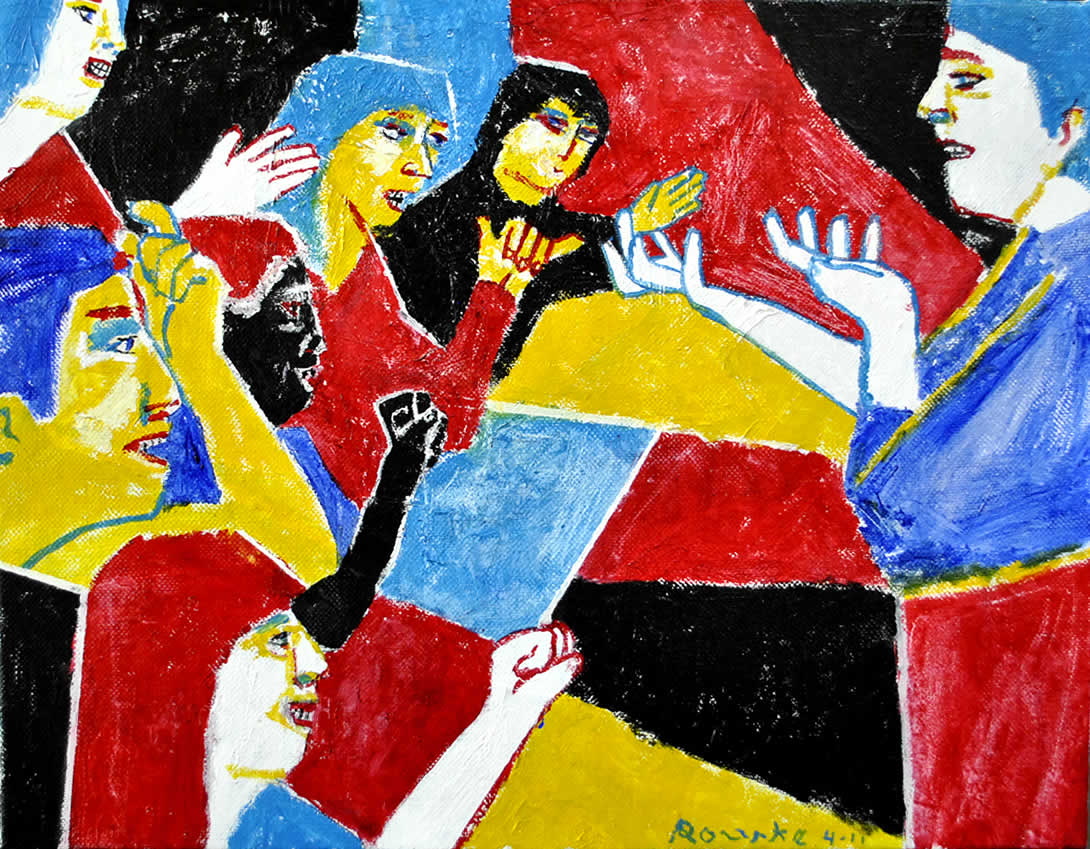
 Nancy Rourke: ASL at ease, 2011. Website.

What sort of forces cause language change? Summarise the article by Gregory R. Guy.

How does language change? Gregory R. Guy makes a distinction between three major types of causes. Firstly internal or spontaneous change, such as sound change, semantic broadening, narrowing or pejoration, coinages etc. This would happen even if the speaker community was entirely isolated from other languages.  The other two types both arise when the speaker community is not isolated, but is in contact with other language communities. In borrowing speakers of a given language (L1) import aspects of another language (L2) into their own. Imposition or interference entails that speakers of L1 inadvertently use rules and devices from L1 when speaking L2, thus affecting L2.

For both language contact causes there needs to be some degree of bilingualism of some percentage of the speaker community, here understood to mean that speakers speak at least a bit of more than one language, wether learned as a child or later on in life. In order to import words from another language one needs to have some sense of what they are used for in that language first.

Furthermore in contact situations, the relative size, dominance, prestige and degree of standardisation of the languages that are in contact have a lot of influence on the linguistic outcome. If one language has a much larger speaker community, the changes will take longer to filter through to each speaker, although a local variant can develop that shows a lot of influence from language contact in that locality. For a small community, language innovations can reach all speakers of the language more easily. Moreover the motivation for borrowing is often based on status. Therefore the direction of the borrowing will be mostly from the more prestigious language to the less prestigious one, e.g. from that spoken by the upper or ruling class to that spoken by lower and middle class people. Interference is usually not as conscious of a choice as borrowing, and therefore it is not status based. It occurs often in learning or shift situations, where one community has to adapt to the language of another, and where bilinguals are likely to be fluent in their native language but in the process of learning the language that the imposition happens to. However in cases of coexistence of two languages, or for balanced bilinguals, the interference can go both ways. Both languages will influence one another.

I am making a distinction between the dominance of a language and its prestige, dominance describing the status of the language in terms of being used for official purposes and spoken by people with more power. Prestige on the other hand is the "coolness" factor, which language is in fashion depending on current ideology. Often prestige and dominance go hand in hand, as with French in modern France, but social upheaval can lead to resistance against a dominant language and preference for another, which then gains prestige. Such would have been the case in Norway during the rise of Nynorsk, by way of protest against the Danish influence.

The degree of  standardisation of a language is important because a language for which there are authoritative reference guides for word meanings, spelling, grammar and pronunciation will be much less inclined to change.


How is the situation of Ulster Scots in Guy's terms?

Ulster Scots coexists in Northern Ireland mainly with English and also with Irish, although the communities that speak Ulster Scots and the ones that speak Irish can be expected to be fairly segregated, i.e. bilingual Ulster Scots and Irish speakers will be rare. There is a coexistence situation, that is, Ulster Scots has been spoken alongside of English for centuries and speakers are not coerced to shift. Yet English is clearly the more sizable and dominant of the languages, being spoken worldwide by about 340 million speakers as a native language and another 430 as a second language (Ethnologue: English). According to the Ethnologue there are 90,000 speakers of Scots in the United Kingdom and 10,000 in Ireland (Donegal), and there is no separate entry for Ulster Scots. Both in Ulster and in Scotland the language has been relegated entirely to the informal sphere, whereas English is used for education and all official purposes. Sheila Douglas writes: "Many Scots people are still half-stifled by a social environment that frowns on the use of Scots for anything more important than casual conversation." Of the people in the communities that speak Scots or Ulster Scots, 97% speak English as well (Ethnologue: Scots) which makes them bilingual speakers.

Due to the revivals of the past centuries Scots and Ulster Scots are gaining in prestige again. Children who speak the language in the playground would now not be beaten, although they might still be corrected. Ulster Scots has benefited from the Good Friday Agreement with considerable funding and some governmental endorsement, and it has been promoted as a marker of a distinct identity.


What can we, therefore, expect to find with regards to language change in Ulster Scots?

Since the speaker community of Ulster Scots consists mostly of balanced bilinguals who use Ulster Scots for informal registers (provided the other speaker understands it) and English for more formal ones, it can be expected that there will be a lot of cross-influence from Ulster Scots on the local variety of English and from English on Ulster Scots.  Due to the great intensity of the language contact this influence can be expected to be quite far-reaching, affecting all aspects of Ulster Scots i.e. phonology, morphology, syntax, lexicon etc. The influence on English as a whole will be small because of English' giant speaker base, and its high degree of standardisation will mean that the local influence is limited to less formal registers as the standard variety is preferred for the more formal ones.

It may be hard to tell apart the effects of borrowing and intereference. Because the speakers are such balanced bilinguals (fluent in both languages) no useful distinction can be made between their L1 and their L2. The only distinction that is then left between borrowing and interference is whether the innovator made a conscious choice to use a certain aspect from the one language in the other, or whether it was a "mistake". Yet this may show variation on a case by case basis - the one's mistake may be another's conscious choice.

Saturday, 8 February 2014

Theory

1. Individual bilingual speakers will transfer aspects from their one language into the other.

2. If a large percentage of a community that speaks a particular language also speaks a particular second language, features of the second language will become a common part of the community's native speech.

3. The overwhelming majority of Ulster Scots speakers are fluent in English as well.

4. Therefore a lot of aspects of English have found their way into Scots.

5. Writing down a mostly oral language creates a reference point for correct use of the language and causes or facilitates standardisation. 

6. When spoken language is written down, changes that have occured in the language will be locked in.

7. Revival authors write down a language that is mostly oral and under threat, often in an attempt to save it from going extinct.

8. Through revival literature the influence of the English language on Ulster Scots becomes standardised.