Showing posts with label history. Show all posts

Friday, 29 September 2017

Timeline of Luxembourgish history and policies on Luxembourgish


...taking into account, of course, that these are only snapshots of a dynamic and changing social context, in which overall historical developments weigh heavier than the policies reflecting them. Nevertheless, a summary of main events.

Let's start with the history up until the fall of Napoleon. The following is all scraped together from Wikipedia and I promise it won't appear in any sort of final project. Frankly, all Wikipedia pages I read have made different selections of events. It seems a fair summary to say Luxembourg passed through a lot of noble hands from different origins: the Bourbons, Habsburgs, Hohenzollerns and the French. From this information you can't really tell how the everyday life of people in Luxembourg was affected, though.

963 Count Siegfried acquires the region and builds the first fortifications of what is now the Casemates.
1345 Luxembourg becomes a Duchy. ("The House of Luxemburg ... became one of the most important political forces in the 14th century, contending with the House of Habsburg for supremacy in Central Europe")
1411 Some dick (Sigismund of Luxembourg) loses Luxembourg because he defaulted on a loan
1451 Luxembourg is further sold on and eventually declared part of the Burgundian Netherlands
1547 and now it's part of the Habsburg Netherlands
At this time, as before and after, Luxembourg was pretty catholic; there were few Calvinists and so they had no problems with iconoclasm. During the 80 years war (1568-1648), they (whoever they is in this case) supported the Spanish king.
1648 Now it's part of the Spanish Netherlands, also known as Southern Netherlands
1684 Invasion by Louis XIV of France during the Nine Years' War of the Grand Alliance.
1697 Treaty of Ryswick - Luxembourg given back to Habsburgers.
1714 End of the Spanish War of Succession (after the last Spanish king died childless). Now Luxembourg becomes part of the Austrian Netherlands (I never knew that there were so many Netherlands through the course of history. Wikipedia notes: Luxembourg wasn't connected to the other Netherlands (Liège sat in between) and so Luxembourg "had a sense of own identity and was turned inwards".)
1795 French rule ("Forêts") because of the Napoleonic wars
1815 Congress of Vienna - Luxembourg gets formal independence and status as a Grand Duchy. Yet it's not really de facto independent because they also gave it to king Willem I of the Netherlands and it's also in the German Confederation.

Now we move on to the more language focused part of the timeline, based mainly on Horner & Weber (2013) but also on some things we heard in class.

1839 Independence of Luxembourg
18.. Law on education
1912 Werner/Engelmann develop an ortography for Luxembourgish that is largely based on German spelling
1914-18 WWI
1940-45 WWII. The Nazis oppress Luxembourgish because it is a "dialect" and enforce Hochdeutsch only. They hold a threefold referendum on Luxembourgish language and identity to which the Luxembourgish protest by voting dräimol Nee!
As a backlash to the Nazi policies, Luxembourgish language-nationalism inflares and French language gains in prestige considerably. German language loses a lot of status for a number of decades.
1948 Ortography that is as differentiated from German spelling as possible and based purely on phonetic principles
1950s-70s Luxembourgish steel industry creates need for a lot of additional labour. Guest workers are brought in from mainly Portugal and Italy, bringing their languages with them. French is closer to Portuguese and Italian than German is. This means that the children of the guest workers later struggle in schools, where teaching is traditionally first in Luxembourgish and German before it switches to French around age 12. It may also (over the next few decades) contribute to an increase of prestige for Luxembourgish as a marker of nativeness.
1984 Language law
1999 CPLL spelling reform
2001 New law on applications for naturalisation stipulate a test of Luxembourgish proficiency for those who want to acquire citizenship

------

For more on this, a book I can recommend is Language Planning in Multilingual Contexts: Policies, communities and schools in Luxembourg, by Kathryn Anne Davis, written in 1994. Here it is on Google Books.

Monday, 24 April 2017

Valkskrantstukje, hier herpost ter kopijbevordering


Carrièrestappen die ik heb overwogen sinds Augustus 2016

Op een berg bij Vélez-Málaga met Kathy. Foto genomen door Stefan.


Schrijver van een boek over hoe normen veranderen

Tijdens het afronden van mijn studie in Luxemburg klampte ik me verwoed vast aan deze droom: om daarna een jaar in Belfast een boek te gaan schrijven waarin ik algemene taalkundige inzichten in hoe taal verandert wilde combineren met mijn persoonlijke inzicht dat taal en normen niet zo heel veel van elkaar verschillen, door dus taalveranderingstheorie op normen toe te passen. Dit zou een wereldschuddend boek worden en beginnen met een analyse van een etiquetteboekje uit de jaren vijftig-zestig wat ik in het Valkenest tegen was gekomen (over o.a. de vraag of je je hoed af moet nemen, of alleen maar knikken, en zoja naar wie, als je als heer alleen een verloofd stel tegenkomt bij het wandelen.) In Belfast aangekomen bleek echter dat ik helemaal geen zin had om me een jaar binnen op te sluiten om academisch geneuzel te typen op mijn computer, nadat ik me net van mijn masterscriptie had bevrijd. Dit idee blijft welzeker op de lange baan, als ik ooit bijv. een aantal weken ingesneeuwd geraak.

SROI-onderzoeker bij Gauge NI

Sinds ik bij de algemene ledenvergadering 2012 van MindWise in het Belfast Castle (een gelegenheid met veel heliumballonnen aan verzwaarde lintjes, waarbij ik indruk op mijn baas maakte doordat één van de schizofrene cliënten speciaal naast mij wilde zitten en aanbood om voor me op te scheppen) een evaluatieverslag van één van de initiatieven van de organisatie doorbladerde, was ik al een groot fan, namelijk van de externe organisatie die in opdracht van MindWise het verslag had verzorgd. Wat een mooie formatting, wat een goede indicators. Gauge NI: een organisatie die enkel als functie heeft om het werk van andere goede doelen beter en effectiever te maken!

Terug in Belfast heb ik ze dus gemaild om te zeggen dat ik hun grootste fan was en dat ik me aan wilde sluiten. Nu bleek dat juist in die week de voormalige hoofdman afscheid had genomen, waarmee de organisatie nog welgeteld één medewerker over had, die alles zelf moest doen. Dat leek me een topgelegenheid om mij aan te nemen om de gelederen te sterken, maar ik geloof dat men daar zelf anders over dacht; ik mocht mee naar een informatiepraatje voor CEOs (alwaar ik per ongeluk versgeperste sinaasappelsap op mijn jurk morste en wel twee !! warme broodjes in mijn jaszakken wist te proppen voor later) en ik mocht wat briefenquêtes uittikken, maar daar bleef het bij. Het laatste nieuws wat ik heb meegekregen is dat ze erover denken om Gauge nu überhaupt te sluiten; waarom is mij niet helder.

Bank Staff Support Worker bij de NOW group

Gauge NI is onderdeel van een grotere organisatie, namelijk de NOW group, een goed doel dat zich inzet voor zwakbegaafde en licht verstandelijk gehandicapte mensen, door middel van opleidingen, stageplekken, persoonlijke carrièrebegeleiders, dagbesteding en sociale bijeenkomsten. Om dichter bij Gauge te komen, mezelf de organisatie binnen te werken als het ware, was mijn idee om een tijdje vrijwilligerswerk bij de NOW group te gaan doen – dan had ik in elk geval contact met de juiste mensen, dan kenden ze mijn gezicht. Ik ben blij dat ik me bij de organisatie heb aangesloten in die zin dat het echt interessant werk was. Ik zat wekelijks bij de trainingsessies Career Planning, waar ik me tussen de cliënten mengde en gedurende de les in de gaten hield of ze het allemaal konden volgen en nog leuk vonden; er was bijvoorbeeld een jongen die niet kon schrijven, maar die wel dol op rap was, en een man die in de bouw had gewerkt en die nu landschapsfotograaf wilde worden, en een jongen die voor een opdracht zijn moeder had geïnterviewd over hoe het is om in een kantoor te werken. Op een gegeven moment is deze positie omgezet in een baantje, namelijk een nul-uren-contract om op oproepbasis hetzelfde soort werk te doen, maar daarna heb ik nooit meer wat van de organisatie gehoord: daadwerkelijk nul uren.

Research & Insight Officer bij de nieuwe Controlled Schools Support Council

De onderwijsstructuur in Noord-Ierland is recent flink omgegooid. Er is een onderscheid tussen het bestuur van katholieke en protestantse (hoe kan het ook anders) scholen; de protestantse werden namelijk door de regering gerund, maar de katholieke scholen hadden zich van de staat afgescheiden en werden door de Maintained Schools Council geleid – en die doen het dus al tijden veel beter. Nu is er ook voor protestantse scholen een dergelijke council opgericht, en daar hadden ze in één keer een heel bataljon personeel voor nodig. Onder de beschikbare posities was er deze, om te kijken welke cijfers de scholen zelf allemaal hadden bijgehouden, en om dat samen te brengen, voort te zetten en uit te breiden. Ik heb het tot het eerste sollicitatiegesprek gehaald, wat een hele officiële ervaring was in een mooi gebouw. Het was een droomrit op de fiets vanaf mijn huis, het hele end langs de rivier de Lagan, en ik wilde het baantje erg graag, maar ik geloof niet dat ze erg onder de indruk waren van mijn stellige bewering dat ik “betrokken” was geweest bij de ontwikkeling van digitale cursusevaluatie op de universiteit Luxemburg (ik had de nieuwe app uitgeprobeerd in ruil voor een Amazon-voucher).

Statistics Officer bij de Northern Ireland Statistics Agency

In voorbereiding op de positie hierboven was ik vast begonnen mijn statistiekkennis op te krikken aan de hand van Khan academy, een boek van Andy Field met plaatjes en een serie R-tutorials. Een vriendin van mij werkt bij NISA en suggereerde dat ik daar ook kon solliciteren, hoewel ze het er zelf niet erg leuk vond; ze zei dat ze niet aan echte statistiek toekomt, maar dat ze voornamelijk de hele dag frequenties zit te tellen, hoeveel mensen er in bepaalde bevolkings­segmenten zitten. Ik heb bij NISA geïnformeerd, maar ik kwam kwalificaties tekort, en ze reageerden nogal bits toen ik vroeg naar de specifieke diploma’s die ik zou kunnen halen om alsnog in aanmerking te komen. Misschien hebben ze het niet zo op jong talent.

Trainee Policy & Public Services Officer bij de National Council for Voluntary Organisations

De NCVO verzamelt informatie over huidig beleid en geeft dat in behapbare vorm door aan goede doelen en andere organisaties die met vrijwilligers werken. Voor dit bijzonder aanlokkelijke baantje (het heeft alles: uitdaging, contact met belangrijke mensen, multicultuur, een hoger moreel doel, een goede locatie, en niet al te hoge vereisten voor de sollicitanten) ben ik speciaal naar Londen afgereist, alwaar ik erachter kwam dat ik helemaal niet voor het sollicitatiegesprek was uitgenodigd, ondanks dat ik mezelf een extreem goede kandidaat vond. Ik ben met een zak koekjes naar hun kantoor gemarcheerd om uitleg te eisen. Ze bleken heel begripvol, lief en bezorgd en legden uit dat ze wel 500 sollicitaties hadden ontvangen. Het was niet zo heel erg allemaal want ik had best een aardige tijd daar in Londen; ik heb drie dagen in mijn nette sollicitatiejasje door Londen gezworven, de nieuwe galerij van Damien Hirst bekeken, een rapconcert bijgewoond in Kilburn, stiekem bier gedronken in Kennington park en mijn make-up laten doen in een station.

Zelfgemaakte oorbellenverkoper op Etsy.com

Als er dan geen vraag naar me is in de wereld van sociaal onderzoek kan ik nog altijd oorbellen gaan maken en die op het internet verkopen.


Pensioneigenaar/huizenbouwer/boer/postbode in een nog te stichten gemeenschap in Portugal

Op een berg in Málaga kwam ik er met vrienden achter dat we allemaal dezelfde droom koesteren om ons eigen huis te bouwen, samen groenten te verbouwen en een anarchistisch pension te runnen ergens in Zuid-Portugal, alwaar volgens mijn moeder complete verlaten dorpen voor een habbekrats te koop aan werden geboden. Rondinternetten suggereert echter dat het wel een half miljoen zou kunnen kosten voor maar een paar kleine huisjes die niet eens bewoonbaar meer zijn, dus vooralsnog moeten we eerst maar eens a) lokaal gaan kijken, b) kapitaal bijeen zien te brengen, en c) relevante vaardigheden ontwikkelen bijv. groenten ver- en huizen bouwen, o.a. door bij bestaande initiatieven mee te gaan helpen. Zodra we een dorp hebben opgericht zijn jullie allemaal uitgenodigd, oké!

Teaching English as a Foreign Language in een spaanstalig land

Ik wil Noord-Ierland eigenlijk weer uit, maar ik geloof niet dat ik al klaar ben om terug naar Nederland te komen, al zijn daar nog zoveel gelegenheden om sociaal onderzoek te doen. Misschien is het omdat Nederland al best wel effectief ís; in andere landen valt er meer te winnen, ofzo. Of sociaal onderzoek hangt me nu voorlopig überhaupt de keel uit.

In elk geval is het plan nu om een intensieve maand durende lerarenopleiding tot TEFL-docent te doen, en dan naar Spanje of naar Zuid-Amerika te vertrekken om daar een jaar (of zo lang als het leuk blijft) Engels te onderwijzen.

*** Update * exclusief bij deze blog!!!! ***

Junior onderzoeker onderwijs en mbo-internationalisering bij een bureau in Nederland

Opvallend maar waar: het blijkt dat er in Nederland heuse onderzoeksbureaus zijn, die specialiseren in het type sociaal geëngageerde onderzoek dat ik graag zou willen doen - en nog best veel ook, in wisselende gradaties van focus op onderwijs en nabijheid tot Rotterdam. In Noord-Ierland is het geloof ik gebruikelijk dat ofwel de organisaties zelf iemand in dienst nemen, ofwel niemand het onderzoek doet. 

Ook de aanmeldingsprocedures verschillen wezenlijk: in Noord-Ierland gaat dat namelijk het merendeel van de tijd per online aanmeldingsformulier waar ze je CV geeneens willen zien, maar waar wel gevraagd wordt om alles wat erop staat nog even te herkauwen. Bij je eigen motivatie voor de baan wordt niet of nauwelijks stilgestaan; de eisen aan de kandidaat zijn hoog en specifiek wat betreft ervaring. Idealiter heb je al vijf jaar precies hetzelfde soort werk gedaan. 

In Nederland daarentegen zie ik voornamelijk de CV+brief-procedure, die aangenaam/zorgwekkend veel ruimte laat voor vrije uitdrukking; eisen aan de kandidaat zijn qua ervaring laag en qua buzzwords die je op jezelf zou toepassen hoog. Bij een aantal traineeschappen waarvoor ik de advertentie las werd die vrije uitdrukking zelfs nog verder opgerekt: daarvoor werd de enthousiaste jonge kandidaten verzocht om een filmpje, essay of papier-maché-maquette te maken waarmee ze zichzelf en hun kijk op de sector origineel presenteren. Ervaring niet vereist.

Tot slot nog dit: waarom eigenlijk onderwijs? Ik zou willen argumenteren dat de interesse in onderwijs voortvloeit uit een interesse voor taalbeleid, waarvoor onderwijs het belangrijkste implementatiemiddel is.  De Master in Luxemburg ben ik gaan doen omdat ik hoopte dat die link daar grondig zou worden uitgediept, wat tot op zekere hoogte (diepte) waar was; er waren vakken over onderwijs, over meertalig onderwijs, over hoe kinderen leren, en over taalbeleid in specifieke gevallen (Luxemburg an sich, Russische en Turkse jongeren in Duitsland, Spaanstalige kinderen in New York, Indiase kinderen in Engeland, het onderwijssysteem in Singapore en in Hong Kong - Oké ik zie nu in dat we het hier wel degelijk uitgebreid over gehad hebben). Tevens een poging mijnerzijde om een clubje op te richten wat tweewekelijkse bijeenkomsten zou hebben over onderwijstheorie. We hebben elkaar een keer of drie, vier getroffen en een dropbox met artikelen aangelegd; in mijn herinnering was het lastig om het gesprek daadwerkelijk op die lectuur te brengen, maar we hebben het wel uitgebreid gehad over de structuur van lerarenopleidingen in Duitsland.

Blogidee voor volgende keer: een lijstje van de boeken over onderwijs die ik sindsdien heb doorgewerkt.
Saturday, 18 June 2016

Zocker, Şeker, Azúcar. Sugar packets as evidence of a changing power balance.

Another thesis done! This is a link to the full thing.


Me with 4 of the copies on the train. Photographer: Gintarė

Abstracts (English, Nederlands, Español):
The position of a language in society is a type of discourse. Even the most banal artefacts with language choices on them are not just results of but participants in that discourse, and they can reinforce it, or challenge and transform it. In this thesis, sugar packets are presented as small samples or fossils of historical language power balances, which can be used to reconstruct shifts in those balances. As a form of ready-collected data, a number of online sugar packet catalogues are used, from which some key information is however missing such as manufacturing dates and finding places. The thesis' methodology is an attempt to utilize the potential of the data by investigating it through four different approaches. After a global overview of differences between the used catalogues, the scope is limited in two different ways. First, the focus is on one city, The Hague, for which the language choices on old and new sugar packets are compared. Next is a comparison of the packets released during the history of three different Dutch department stores. Finally, the study zooms in on a single sugar packet, to trace in detail its journey and the choices made during it. The data show a clear difference between “linguistic fetish” type use of foreign languages, whereby they are employed to call up positive connotations, and “instrumental” use, which is directly related to the companies' cross-border activities. Specifically this “instrumental” multilingualism occurs ever more often, as a result of the dynamics of franchising and foreign expansion during the period which is researched.

De machtspositie van een taal in de maatschappij is een diskoers. De taalkeuzes in of op welke tekst, uitspraak of onbeduidend object dan ook zijn niet alleen resultaten van dat diskoers, maar nemen erin deel, door het te herhalen en voort te zetten, of door het aan te passen en een nieuwe richting te geven. In deze scriptie worden suikerzakjes aangegrepen als kleine staaltjes of fossielen van historische taalbalansen, die kunnen worden gebruikt om de verschuivingen daarin te reconstrueren. Bij wijze van kant-en-klare data maakt de studie gebruik van een aantal door verzamelaars bijeen gebrachte online catalogi van suikerzakjes, waarin echter bepaalde cruciale informatie mist zoals wanneer de zakjes zijn gedrukt en waar ze zijn gevonden. De methodologie van de scriptie is een poging het potentieel van de data tot bloei te brengen met vier benaderingen in toenemende mate van detail. Na een overzicht van onderlinge verschillen tussen de catalogi volgen twee verschillende manieren om het bereik van de studie te beperken, eerst met een focus op suikerzakjes uit één stad, namelijk Den Haag, waarbij taalkeuzes op nieuwe en oude zakjes worden vergeleken, en vervolgens met een vergelijking van de suikerzakjes uitgebracht gedurende de geschiedenis van drie Nederlandse warenhuizen In de laatste analyse wordt de focus verscherpt op één enkel suikerzakje, om het door het zakje afgelegde pad te traceren en de daarbij gemaakte keuzes in hun context te plaatsen. Uit de data blijkt een onderscheid tussen „dwepend“ gebruik van vreemde talen – waarbij ze worden ingezet om positieve associaties op te roepen – en „instrumenteel“ gebruik, direct gerelateerd aan grensoverschrijdende economische activiteit van de bedrijven. Specifiek deze „instrumentele“ meertaligheid komt steeds meer voor als gevolg van het ontstaan van franchises en toenemende internationalisering van bedrijven tijdens het door het onderzoek beslagen tijdsbestek.

La posición de un idioma en la sociedad es un discurso. Cada texto, objeto o acto de habla, junto con las selecciónes de idioma que se encuentran en estos, incluso en los más triviales, no son solamente resultados de este discurso sino que también hacen parte de éste y pueden reforzarlo, rebatirlo y transformarlo. En esta tesis, los paquetes de azúcar se presentan como muestras o fósiles de equilibrios históricos de poder lingüístico, cuyos cambios pueden ser reconstruidos mediante el análisis de estos vestigios. Como “corpus prefabricado” se utilizan catálogos en línea de paquetes de azúcar, recopilados por coleccionistas. Sin embargo, faltan informaciónes tales como las fechas de producción o los lugares donde se hallaron los paquetes. La metodología de la tesis busca aprovechar el potencial de dichos paquetes desde cuatro enfoques de investigación diferentes. Se empieza presentando un panorama general de las diferencias entre los catálogos y entre los sistemas nacionales de distribución de azúcar. Luego, para limitar el alcance de los datos, se comparan las selecciones de idioma hechas, en primer lugar, en paquetes nuevos y antiguos de la ciudad de La Haya, y, en segundo lugar, en los paquetes creados a lo largo de la historia de tres almacenes neerlandeses. Por último, la investigación se enfoca en un único paquete para observar en detalle su recorrido y las decisiones tomadas en este proceso. Los resultados muestran una clara distinción entre el uso de idiomas extranjeros de dos maneras: como “fetiche lingüístico” y de forma “instrumental”. En la primera, los idiomas son usados para evocar asociaciones positivas, mientras que la segunda está directamente relacionada a las actividades transfronterizas de las empresas. Este tipo de plurilingüismo “instrumental” particular occure cada vez más seguido, como resultado de las dinámicas de creación de franquicias y de expanción internacional durante el periodo investigado.

Monday, 19 October 2015

Film review: Crimson Peak

Warning the following is made of spoilers.


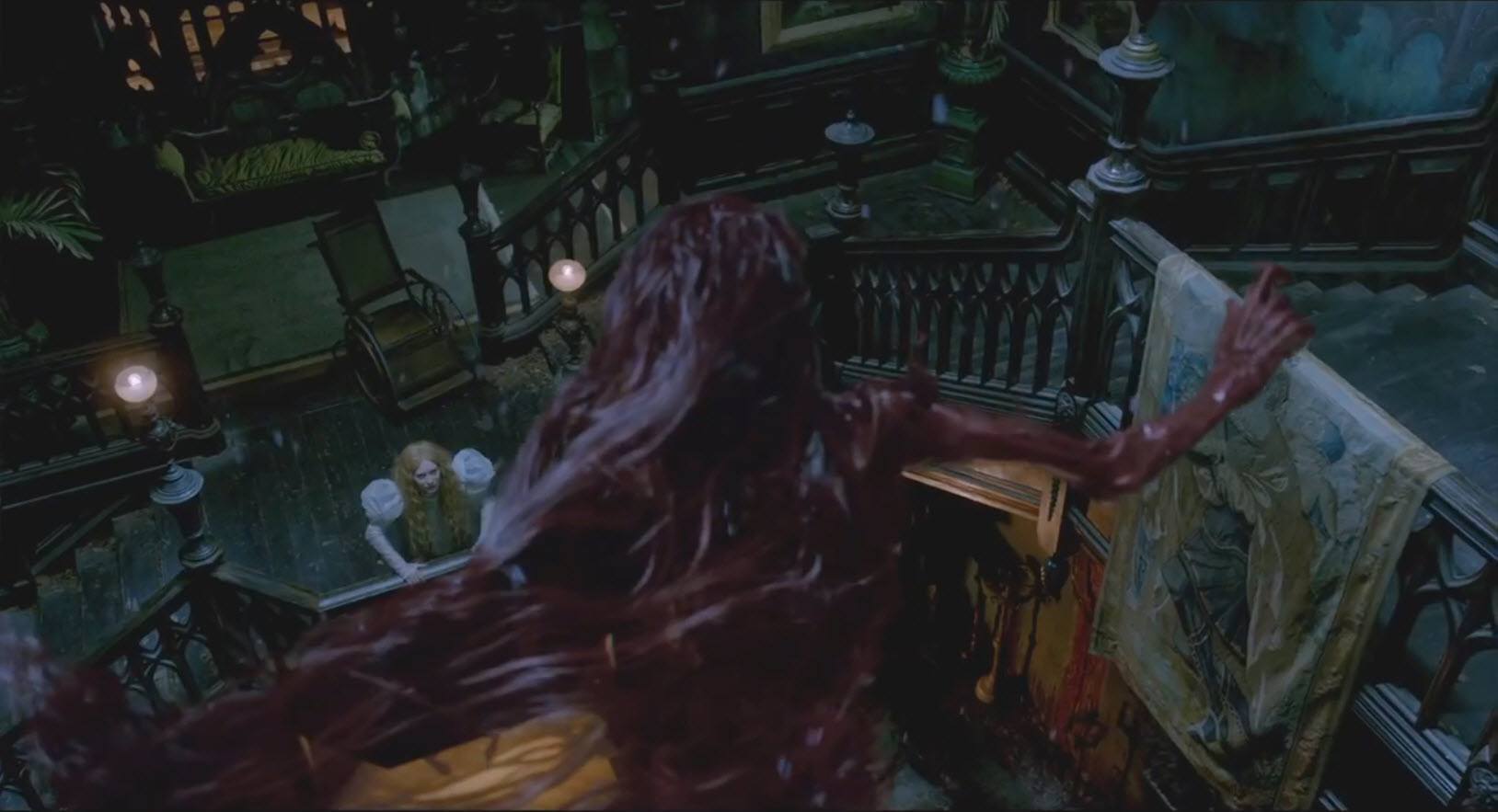
Edith sees a ghost in the corridor. Image used by another review of the film at Tale of Two Dans. Also interesting: WrongReel review

Gintarė and Mariana took me to a film that I don't think I would have thought of going to see if it had been just me. It wasn't part of the CinÉast festival that we have been seeing films from over the past few weeks - films that are all very realistic and based on all sorts of pressing social issues (dealing with pedophilia, terminal illnesses, being transgender, lesbianism, poverty, learning disabilities, losing a loved one etc.) This was a big Hollywood film with an impressive budget, by the looks of it, and a fantastical story (in the sense that it wasn't convincingly close to everyday reality). The costumes had elaborate puffed sleeves and colour themes to express the personalities of the characters. The setting was partially in a dilapidated castle with a quaint mechanic elevator and a number of inexplicable but worrying basins of thick red liquid in the basement. The story was set in fin-de-siecle New York and England, so I'm not entirely sure if that is the kind of costumes that would have been worn at the time. Something tells me at least their nightgowns wouldn't have been as intricately puffed and pleated. 

Yesterday me and my mother went to see Ciało (Body), which dealt with different understandings of the relation between body and soul, according to the flyer. There was a cynical procurator who thought when a person died, or is stuffed in a toilet as an infant for that matter, they don't go anywhere. They just die. He didn't really seem to grieve his deceased wife very much, ostensibly, but his daughter really did and was openly suffering. Then he brings her to a therapist who is a medium and who senses the presence of the mother near to the father and the daughter and who is convinced the mother wants to contact them. 

That story dealt with ghosts in a subtle and philosophical sort of way. The way people experience the death of others becomes almost just a sort of personality quirk to help characterise the people in the film. In Crimson Peak, however, the ghosts are not a subtle presence whatsoever. They are maimed blood-dripping skeletons, dragging themselves over the floor and screeching, suddenly bursting through closed doors while the music plays dramatically. Yet as I understand it, the ability to see them is still somewhat of a personality quirk of the main character. In the film, the ability to see ghosts is compared to (not) being colour blind. The girl (Edith) is initially scared of the ghosts, which I suppose I would be what with all the dramatic music, but eventually she realises they are conveying useful information on how to further the plot, and she tries to communicate. When she first goes to the castle and starts seeing ghosts, she tells the others about them, but they don't understand what she is talking about. Then again, the others (poor but noble English siblings Thomas and Lucille Sharpe) may be trying to hide their awareness of the ghosts, as it turns out they originally caused them to haunt the place by brutally murdering them. At the end, it seems Lucille is able to see Thomas' ghost when Edith points him out to her. 

The cause for the siblings' brutal murder rampage seems to be that they need money to keep on living in their dilapidated castle, hiding away their twisted sexual relationship from the world, and to start a clay mine to dig up their weird red clay for some reason. Thomas tempts rich young female outcasts into marrying him, Lucille makes sure their parents are dead too; then she poisons the girls slowly while prohibiting her brother from sleeping with them and while all their dead parents' money is being transferred to the castle's accounts. The explanation for especially the sister's evil mind is that their mother was very harsh and loveless to them, and the sister stood up for her brother and took all the beatings, which made her rather crazy in the head (the CinÉast films probably wouldn't have taken this rather socially irresponsible route of depicting someone with mental illness as relentlessly violent). The brother however is mainly motivated by love: he participates in the crimes out of love for his sister, and he eventually tries to stop them out of love for Edith.

I saw some parallels to the horror stories David Graeber analyses in Debt: the story is really about how the nobility exploits the working people to pay their own debts. The Sharpe's family fortune has been squandered by the siblings' father (who disappears out of the picture mysteriously after Lucille kills their mother). Thomas originally meets Edith because he is trying to convince the council her father is on to fund his mining project. Her father chews him out about never having had to work for his money (he gets killed for that later, the father); at the start of the film Edith herself also says a Baronet (Thomas' title) is probably a parasite. And she was not wrong: indeed they turn out to be pretty much literally parasites. The nobles are not exactly vampires in this film, but it bears a lot of similarity: they are dressed the part for it and they kill hardworking people such as Edith and her father in order to continue their own disturbing life. Thinking about it it seems like vampires are usually nobles in most depictions of them.

What's more: the moral of how the nobility exploits the working people is itself a device to promote the USA as a great country, versus its former feudal overlord England. England is the place where the castle of the Sharpe siblings is situated. Edith and her father live in Buffalo, New York, but when the father is berating Thomas' request for money he says now he's come "to America" to ask for money (so not just to NY but it's generalised). It fits into the greater picture where America has always profiled itself as a place where you can become rich through hard working, and where class differences are abolished -- everyone wears jeans, everyone drinks Coca Cola. England on the other hand is ruled by a monarch and a House of Lords (also a House of Commons but that is not relevant here). Those with fancy birth-given titles help themselves to e.g. mines they haven't earned. Most of all, the clearest stab at England is the method through which Lucille kills her victims: by making them drink poisoned tea.

Mariana laughed when I said the bit about the nobility - as far as I understood, she and Gintarė thought the film was about the horrible things people will do in the name of love. Which is also a fair interpretation. One thing I still missed in their analysis, though, was the role of the ghosts. Edith writes ghosts stories, but whenever anyone reacts cynically, she explains it's not really a ghost story: the ghosts are just a metaphor. So what are they a metaphor for? I say it's the stories of exploitation from the past, well as bloody as this film's dripping ghosts, to which people shouldn't close their eyes if they want to know how to further the plot.